Welcome!

Welcome to my zone 9a habitat garden near Houston, Texas.

Saturday, July 13, 2013

Point of view - July edition

Regular readers will remember that I started this project back in January. I was going to do pictures from a certain spot in the garden - I chose an area just in front of my garden shed - each month and post them here to show how the garden changes through the year.

I managed to take my pictures and post them every month up until June. In June, I was out of town in the middle of the month when I normally do this post and so just never got to do it. But now it's July and here I am again!

To remind yourself of what this area looked like in previous months, here are the links.

January

February

March

April

May

And now, here's July:

Standing in front of the garden shed and shooting down the path toward the house. These pictures were taken at mid-day today and so there are strong shadows and bright sunshine.


Same general area - just a slightly different angle.


Turning the camera to the right and shooting toward the house, you can see the lush growth of the plants around the pond on the left and the RAMPANT growth of the Anisacanthus wrightii (flame acanthus) hedge on the right. What you can't see is that the flame acanthus is full of various kinds of bees and butterflies and a couple of hummingbirds, all of which love those tiny orange flowers.


In the distance, you see crape myrtles in bloom.


Walking a bit closer to the house, you get a view of the patio and the plants around it.

Even though we are in a drought and I'm having to employ the sprinklers and the hose and watering can to keep plants from completely drying out, all of the plants that are well-established, the ones that have been in place for years, are growing like crazy and blooming like crazy. They are mostly very tough plants that can take the heat and drought, not to mention the humidity. I only wish the gardener were as well adapted!

Friday, July 12, 2013

This week in the garden - #71

This was the week when I finally had to admit that my old blueberry shrub that had been so productive for more than twenty years was dead and it wasn't coming back. R.I.P, old friend.

I'm sure it was the drought that did it in, even though I tried to keep it watered. The last three years, including this one, have been really tough on the old girl and, in the end, it was just too much.

I drafted my assistant gardener/hubby to remove it for me.

Meantime, I got a big pot, filled it with potting mix, and dug the other blueberry shrub that I had planted in the yard, and plopped it into the pot. It's much smaller and younger than the old shrub, and I hope I'll be able to save it by growing it in the pot. Another blueberry that I have in a pot has been doing well, so that gives me hope. The newly potted shrub has joined all the other plants in my plant hospital under the magnolia tree.

*~*~*~*

Many of the planting beds in my garden are sorely missing mulch, so this week we got a pickup load of the stuff to begin replenishing the bare beds. Of course, it will take several pickup loads to do all the beds that need to be done, but one has to start somewhere.

*~*~*~*

Summer is crape myrtle season. (Yes, I know some modernists spell it "crepe," but I'm sticking with the old-fashioned spelling!)

 In addition to the pretty pink one above, I have this one, which I think of as watermelon-colored, in bloom now. I crave a deep purple one and a white one, but I don't know where I would plant them.


 There have been a few more butterflies around the yard this week, including this Gulf Frittilary at the flame acanthus blossoms today.


Along with the butterflies were lots of honeybees and also many of these large carpenter bees. They all love the flame acanthus.


'Senorita Rosalita' cleome has been in pretty much constant bloom since I brought her home from the nursery this spring. That robustly growing vine on the fence behind her is a Dutchman's Pipe vine, awaiting the attentions of the Pipevine Swallowtails.


The firecracker plant by the fountain is offering up lots of these tubular shaped blooms that the hummingbirds love.


Several of the lantanas around the garden are flagging in the heat and drought, but the 'Dallas Red' seems to thrive in it.


Pretty 'Darcy Bussell' rose is in bloom again.

And the old crinums that we know as "Milk and Wine lilies" started blooming this week.

In spite of baking in the sun every day, some plants just keep on going and blooming.

*~*~*~*

I haven't forgotten about my "point of view" series. I was out of town during the week in June when I normally post those pictures, but I will be showing you the July view. Tomorrow.    

Wednesday, July 10, 2013

Wordless Wednesday: Datura


Monday, July 8, 2013

The invasion of the decimators

(Cross-posted from Backyard Birder.)

There are many challenges facing the environment around the country, indeed around the world, these days, but among the most deadly and seemingly intractable of these are the invasives.

Invasives are plants or animals from someplace else in the world that have been brought to our shores, sometimes deliberately, sometimes by accident, and released or escaped here. Often these plants or animals find a hospitable habitat with none of the natural enemies or controls which they encountered in their native land. The predictable result is that their population explodes. They compete with native species and sometimes overcome them, even wiping them out.

In the island nation of New Zealand, for example, where non-native rats and stoats have become entrenched, they haveexterminated at least 19 bird species.    

In the United States, one of the most famous invasives is theHouse Sparrow, which was deliberately introduced in New York in the 19th century. It quickly spread and began to compete with native hole-nesting birds like Eastern Bluebirds and Tree Sparrows, contributing to a decline in these as well as other species before human intervention began to give the natives a fighting chance.

In the 20th and 21st centuries, with the globalization of the economy and the ease of tourism between countries, the rate of introduction of invasives exploded. No state in the country has suffered more from this phenomenon than Florida.

From walking catfish, Asian swamp eels, Cuban tree frogs, monkeys, iguanas, and, most famously, Burmese pythons, the state's ecology  is overrun by invasives. Indeed, the pythons have been so successful in the Everglades that they have virtually wiped out the small mammal population there. This, of course, has disastrous and long-term effects on the other predators in the area that normally depend on these mammals for food.

Even the alligators there have had trouble holding their own against the pythons. Bodies of the native reptiles have been found in the stomachs of big pythons that have been captured and killed.

As if all of this were not enough, Florida is now battling another invasive - giant African land snails, sometimes called GALS. These snails can get up to 8 inches long. Each snail contains both male and female reproductive organs and every mated snail lays about 1200 eggs a year. As of June 22, Florida state officials reported that they had captured and killed more than 124,000 of the snails in the area around Miami.

These snails pose a major threat to gardens and to farmers' crops because they will feed on and destroy at least 500 different types of plants. But it's not just plants that they gobble. They will also chew on plaster and stucco, thus causing damage to homes. And, one other thing: They also carry a parasitic nematode that can lead to meningitis in humans. Unbelievably, these critters were deliberately smuggled into the country by a religious cult which uses them in their "healing ritual."

Florida is battling its invasives with all available resources, but in all too many instances it seems to be losing the battle. There is always the chance that many of these species will be able to spread to other hospitable habitats, especially in adjoining states along the Gulf of Mexico. As the climate changes, becoming warmer, the possibility of some of the species being able to move into even more areas of  the country only increases, all of which could prove to be devastating for our native plants and animals. The decimation of species which Florida has experienced could become more widespread.

It is a nightmare scenario, one that desperately needs a solution but for which no real workable solution seems in sight.

Friday, July 5, 2013

This week in the garden - #70

For the most part, this week's weather has been on the pleasant side, though bone dry. The daytime temperatures have been in the low 90s and at night on occasion the thermometer has dipped into the 60s. All that changed today when the temperature rose again to 98 degrees at 1:05 in the afternoon.

I was actually in the garden doing some deadheading and pruning when the high was reached and I can attest that it was miserably hot. I sat down on the patio to rest for a while, but the patio is in full sun. The only shade at that time of day comes from umbrellas. I found it unbearable to sit there and so I moved over to the bench under the magnolia tree near the pond. Instant relief!

Sitting under the magnolia tree felt at least 20 degrees cooler. I felt like I had walked into an air-conditioned room. It's amazing what a difference a tree makes.

*~*~*~*

While I was sitting on my bench, I had my camera at my side, because one of my purposes in being outside at that time of day was to try to photograph butterflies. I've written here before about the scarcity of butterflies in the garden this summer. The populations of most species seem to be down considerably over recent years, but I've been noticing this week that there are a lot of the small butterflies around. I'm still not seeing so many of the big, flashy types like the various swallowtails or Monarchs, but there are an abundance of skippers and hairstreaks.

The bench, in addition to being in a cool shade, is located right next to the flame acanthus which is in full bloom now.

The flame-like flowers are a major draw for butterflies so I hoped I might be able to photograph some while I sat there.

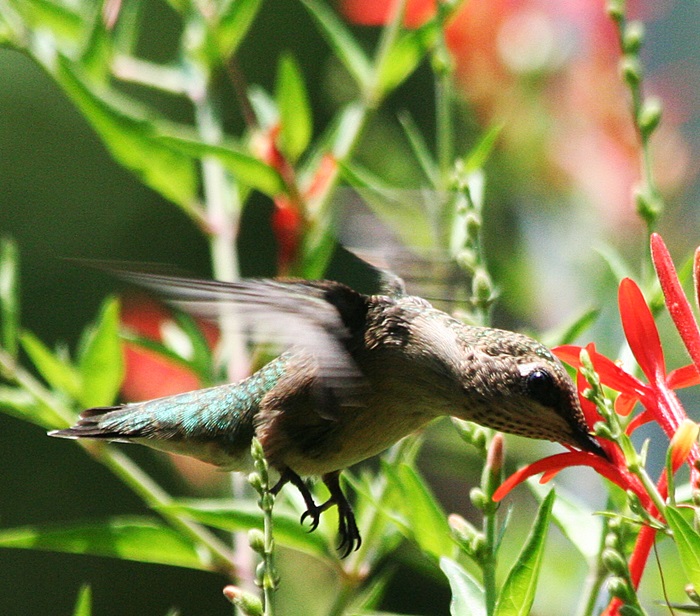
To my surprise, a different kind of flier showed up. This is my resident female Ruby-throated Hummingbird who I suspect has a nest somewhere in the yard but I haven't discovered it. She loves these blossoms, much preferring them to the sugar water in the feeder that I keep filled for her.

There were several Cloudless Sulphurs like this one around the garden this week.

 As well as a few Gulf Fritillaries.

And I did actually see a couple of Monarchs.

But the stars of the butterfly extravaganza this week were the smaller butterflies.

There were little Gray Hairstreaks everywhere I looked - especially on the almond verbena blooms. There were at least half of dozen of these butterflies on the shrub.

But they weren't the only ones drawn to the almond verbena. There were a number of these unknown species of bees all over the plant.

 In fact, everywhere I went looking for butterflies today, I found various kinds of native bees.

But I also found plenty of little butterflies, like this Fiery Skipper on a purple lantana blossom.

Some of the skippers are difficult to identify for they have no outstanding field marks. This nondescript little guy is (I think) a Swarthy Skipper.

And this one (again, I think) is a Clouded Skipper.

No doubt about this one. It is a Tropical Checkered Skipper.

So, it wasn't a bad week for butterflies. Maybe things are beginning to pick up.

*~*~*~*

There were several new blooms this week.

 'Pride of Barbados' started sending out its fiery blossoms. (Blooming behind it is yellow cestrum.)

My old yellow hibiscus is blooming again. It dies back to the root in winter and I'm always in suspense as to whether it will come back in the spring. So far, it has come back each year.

The bleeding heart Clerodendrum is not a new bloomer but it has been especially beautiful this week.

And the white 'Texas Star' hibiscus joined the bloom parade this week. Its red cousin has been blooming for weeks already.

*~*~*~*

The ten-day forecast offers us some chance of rain in coming days, but those promises have a way of dissipating as the day in question gets closer. We'll see if this time is different. There is allegedly some activity in the Gulf that may form up and bring rain our way. Fingers crossed!

Thursday, July 4, 2013

Happy Fourth of July!


And divided we fall.

Happy Independence Day!

Celebrate safely.

Wednesday, July 3, 2013