Did you happen to see HBO's latest documentary, Birding: The Central Park Effect? It premiered last night, but, if you care to see it, I believe it will be showing a few times later in the week or you can watch it on HBO On Demand, if you have that feature. It's worth a look if you are interested in birding or birds or even if you just have a concern about the environment and what is happening to it.
I didn't see the show last night because I was watching the Astros game (Finally won one! Yay!) but I watched it today with my two cats. The bird photography and sounds were so realistic that it kept the cats' attention. In fact, it even had them jumping at the screen on occasion!
The film follows a group of regular birders in New York's Central Park through a year of watching the birds there. Some of them are fairly famous (at least in some circles) - people like authors Jonathan Franzen and Jonathan Rosen - but most of them are just regular people, New Yorkers with typically busy lives who are also obsessed by birds.
One of the most interesting of the lot for me was a woman with terminal breast cancer who leads bird walks through the park and has done for many years. She explained what the park means to her, basically that it takes her out of herself and out of her pain and reminds her that she's still here. She's still alive. And there are still birds to see and to share with others.
Another featured birder was a young African-American man who said that his friends know that he is going to disappear in the spring and that they will not see him again until spring migration is over. He was particularly interesting to me, because, so often, especially in this area, birding is perceived as a very white activity. It's heartening to see that this is not true everywhere.
This man, Chris Cooper, had formulated seven reasons why birding is interesting and important. Basically, his reasons had to do with the beauty of the birds, the connection they give us to Nature, studying birds and bird behavior as an entry to the world of science, etc. His last reason was "the unicorn effect." Essentially, this means that you come to know birds through studying them in field guides. You memorize them long before you ever see them. And then one day you finally see that picture that you've been studying come to life in the field and it's like the sensation of watching a unicorn emerge from among a stand of trees. Any birder will know what he's talking about.
Those are some of the birders, but what of "The Central Park Effect"? This refers to the fact that migrating birds are funneled into this green oasis in the middle of a highly urbanized area, so that at the height of the migration seasons, you can get millions and millions of birds coming into the park to feed and rest. Because they have nowhere else to go! This is a boon for the birders, of course, and it's certainly a boon for the birds that there is such a place. It is also sad for the birds that it is one of the few such places left.
It's not only New York that has a Central Park effect. Cities all over the country, with their urban parks, have the same effect, albeit perhaps to a lesser degree. Houston, with its many parks and nature preserves, has many such oases to sustain the birds on migration or even during nesting. It's one of the reasons that ours is one of the birdiest places in the country. But most, if not all, cities have some such "natural" areas, even if, like Central Park, their "Nature" is completely planned and landscaped by humans. These areas are absolutely essential to the survival of birds and much other wildlife in our urban society.
One's own garden can play a similar role. Even a postage-stamp-sized plot that is planned and planted for the benefit of wildlife can be a haven and a life-saver for hungry birds and other animals. That is why the growing popularity of habitat gardening has been one of the more heartening trends in gardening over the last few years.
While birding probably will never be considered by the general population as a "cool" activity, for reasons that Jonathan Franzen explains in the film, even those who are not bird-addicted may gain a better understanding of their relatives and friends who are by watching this interesting documentary.
(Cross-posted from The Nature of Things.)
Showing posts with label birds. Show all posts
Showing posts with label birds. Show all posts
Tuesday, July 17, 2012

Tuesday, November 29, 2011
The frost is on the pumpkin!
We've had light frost for the past two nights as temperatures dipped into the lower 30s. I thought at first that the frost really had not done much damage but as I walked through the garden this afternoon, it was clear that all the tenderest of the plants are gone. Banana tree - gone. Cannas - gone. Porterweed - gone. Tithonia - gone. Several other plants, such as Hamelia patens, got nipped but still have some green leaves.
This was the first warning to plants to get ready for colder weather and many of them that had not already started the process will be shutting down now. By this time next month, the garden will be a very different place.
I welcome the change. Winter is coming and it will be a needed respite for both garden and gardener, a time to gather our energies for the busy seasons to come. A time when the major activity in the garden will switch from actual gardening to watching the birds and making sure their feeders are kept full. There's always something to do in the garden - even if it isn't strictly speaking gardening.
This was the first warning to plants to get ready for colder weather and many of them that had not already started the process will be shutting down now. By this time next month, the garden will be a very different place.
I welcome the change. Winter is coming and it will be a needed respite for both garden and gardener, a time to gather our energies for the busy seasons to come. A time when the major activity in the garden will switch from actual gardening to watching the birds and making sure their feeders are kept full. There's always something to do in the garden - even if it isn't strictly speaking gardening.
Friday, April 23, 2010
A Friday stroll through my garden
What's the use of having a garden if you can't stop occasionally and enjoy it?
I had a busy day of gardening today and I barely even scratched the surface of what needs to be done, but that's what tomorrow is for. Today, I decided to stop for a bit and take a stroll through the garden to see what I could see. I took the camera with me.
A few years ago, when I was about to add some roses to the garden, I offered my younger daughter the opportunity to pick one variety to add. This is the one she chose.

It is 'American Beauty.' I think she was taken with the name more than the rose itself. Maybe she had just seen the movie by that name. For whatever reason, this is what she chose. It would not have been my choice probably, but, oh well... We sent our order off to Antique Rose Emporium and then planted the rose bush and waited. For the first three or four years of its life, it didn't do much for us, and finally I moved it to an out-of-the-way bed next to the garden shed. It seems to like that spot. It bloomed well last year and this spring it has been absolutely glorious. Maybe Sarah didn't make such a bad choice, after all.

This is what the blossoms look like, close up. They also have a nice fragrance. My mother used to grow this rose when I was little so I have good memories of it.

As I walked around the garden, I saw this anole displaying on the veggie garden fence. I tried to get a picture of him with his red throat pouch expanded, but he wouldn't cooperate. Then he caught a bug and stopped to have a snack. No more displaying for a while!

The 'Early Sunrise' coreopsis has started its bloom.

So, too, finally, have the amaryllis.

'Apple Blossom' amaryllis is several weeks later than last year, but who's complaining? I'm just happy to see these wonderful blooms.

And here's a very different kind of beauty! This is the caterpillar of the Giant Swallowtail butterfly. Can you see why it is called the 'bird dropping' caterpillar? This one is very new. That's my thumbnail on the corner of the leaf, so you can judge the size of the larva.

Here's a second caterpillar. There may have been more but two were all I saw. I hope they do not attract the attention of the wasps as, unfortunately, my Monarch caterpillars did. But these guys are very well disguised. I'm not sure that even a wasp would be interested in a bird dropping.

On a trellis next to the garden gate, the Mexican flame vine shows how it got its name.

Near the vine, this heliotrope provides a bright counterpoint of color.

Through the garden gate and into the front yard, the bed at the entry of the house is beginning to fill in nicely. Those two taller plants in the back are Texas Star Hibiscus on the left and 'Fourth of July' buddleia on the right. The hibiscus has come back strongly from last year, as has the buddleia. This buddleia bloomed beautifully for me last year, all summer and fall, right up to the first frost.

At the post "bird" feeder in the front yard, three rather furry "birds" settle down for a snack.

While at the backyard feeder where squirrels are forbidden, the White-winged Doves reign.

This purple verbena never completely went down during the winter and was one of my first plants to come back into bloom this spring.

'Graham Thomas' didn't get in any hurry at all to give me that first bloom, but I guess he's worth waiting for.

Yes, he's definitely worth waiting for.

Not to be outdone, in the backyard, 'Dortmund' has been putting on a nice show.

'Yesterday, Today, and Tomorrow' also is showing us some color.

I love the 'Red Cascade' with its miniature red roses. It is full of buds but so far has shown only a few blossoms.

The backyard birdbath was a popular spot today, especially with this mockingbird. Taking care of a nest full of babies is hard and thirsty work!

Leave it to a Blue Jay, though, to know what a birdBATH is really for!

I love the way this Mexican feather grass in the bottletree bed moves in the wind.

After a hard morning of gardening, it's time for a catnap in the shade! I know just how Nicholas feels.
I had a busy day of gardening today and I barely even scratched the surface of what needs to be done, but that's what tomorrow is for. Today, I decided to stop for a bit and take a stroll through the garden to see what I could see. I took the camera with me.
A few years ago, when I was about to add some roses to the garden, I offered my younger daughter the opportunity to pick one variety to add. This is the one she chose.

It is 'American Beauty.' I think she was taken with the name more than the rose itself. Maybe she had just seen the movie by that name. For whatever reason, this is what she chose. It would not have been my choice probably, but, oh well... We sent our order off to Antique Rose Emporium and then planted the rose bush and waited. For the first three or four years of its life, it didn't do much for us, and finally I moved it to an out-of-the-way bed next to the garden shed. It seems to like that spot. It bloomed well last year and this spring it has been absolutely glorious. Maybe Sarah didn't make such a bad choice, after all.

This is what the blossoms look like, close up. They also have a nice fragrance. My mother used to grow this rose when I was little so I have good memories of it.

As I walked around the garden, I saw this anole displaying on the veggie garden fence. I tried to get a picture of him with his red throat pouch expanded, but he wouldn't cooperate. Then he caught a bug and stopped to have a snack. No more displaying for a while!

The 'Early Sunrise' coreopsis has started its bloom.

So, too, finally, have the amaryllis.

'Apple Blossom' amaryllis is several weeks later than last year, but who's complaining? I'm just happy to see these wonderful blooms.

And here's a very different kind of beauty! This is the caterpillar of the Giant Swallowtail butterfly. Can you see why it is called the 'bird dropping' caterpillar? This one is very new. That's my thumbnail on the corner of the leaf, so you can judge the size of the larva.

Here's a second caterpillar. There may have been more but two were all I saw. I hope they do not attract the attention of the wasps as, unfortunately, my Monarch caterpillars did. But these guys are very well disguised. I'm not sure that even a wasp would be interested in a bird dropping.

On a trellis next to the garden gate, the Mexican flame vine shows how it got its name.

Near the vine, this heliotrope provides a bright counterpoint of color.

Through the garden gate and into the front yard, the bed at the entry of the house is beginning to fill in nicely. Those two taller plants in the back are Texas Star Hibiscus on the left and 'Fourth of July' buddleia on the right. The hibiscus has come back strongly from last year, as has the buddleia. This buddleia bloomed beautifully for me last year, all summer and fall, right up to the first frost.

At the post "bird" feeder in the front yard, three rather furry "birds" settle down for a snack.

While at the backyard feeder where squirrels are forbidden, the White-winged Doves reign.

This purple verbena never completely went down during the winter and was one of my first plants to come back into bloom this spring.

'Graham Thomas' didn't get in any hurry at all to give me that first bloom, but I guess he's worth waiting for.

Yes, he's definitely worth waiting for.

Not to be outdone, in the backyard, 'Dortmund' has been putting on a nice show.
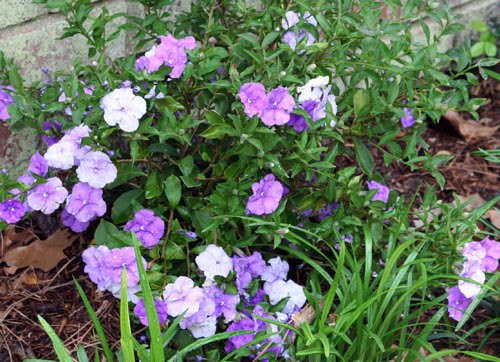
'Yesterday, Today, and Tomorrow' also is showing us some color.

I love the 'Red Cascade' with its miniature red roses. It is full of buds but so far has shown only a few blossoms.

The backyard birdbath was a popular spot today, especially with this mockingbird. Taking care of a nest full of babies is hard and thirsty work!

Leave it to a Blue Jay, though, to know what a birdBATH is really for!

I love the way this Mexican feather grass in the bottletree bed moves in the wind.

After a hard morning of gardening, it's time for a catnap in the shade! I know just how Nicholas feels.
Monday, February 1, 2010
National Bird Feeding Month
Do you know what the second most popular hobby in America is? If you guessed bird feeding, you are absolutely correct. We spend $3 billion per year on bird seed. That is a lot of bird seed!
Some of us keep our feeders stocked twelve months of the year, but there is no month when those feeders are more relied upon by the birds than in February. For that reason, February has been named as National Bird Feeding Month.
In February, we are reaching the mid-point of winter and most of the wild food that many seed-eating birds depend upon has been exhausted, at a time when much of the country is still facing harsh weather conditions. While harsh weather is not a serious obstacle for most birds, lack of food certainly is, so it is now more important than ever that those bird feeders be kept stocked with high nutrition food.
Some of the best foods include suet, peanut butter, peanuts, sunflower seeds (especially black oil), and safflower seeds. Add thistle seeds for the finches and you've got a smorgasbord to which seed-eating birds will flock from all over your neighborhood.
When I open the door to my backyard early in the morning on these winter days, literally hundreds of birds fly up from the feeders and the ground under the feeders. A majority of these are goldfinches, but there are also sparrows, warblers, and doves. It is a most gratifying sight and all the encouragement I need to keep the bird seed flowing.
I hope that you are keeping your birdfeeders well stocked, also, or if you haven't put up a feeder yet, there's no better month than this, National Bird Feeding Month, to do so. The birds will thank you for it.

A male Red-bellied Woodpecker has a snack at one of my backyard feeders.
Some of us keep our feeders stocked twelve months of the year, but there is no month when those feeders are more relied upon by the birds than in February. For that reason, February has been named as National Bird Feeding Month.
In February, we are reaching the mid-point of winter and most of the wild food that many seed-eating birds depend upon has been exhausted, at a time when much of the country is still facing harsh weather conditions. While harsh weather is not a serious obstacle for most birds, lack of food certainly is, so it is now more important than ever that those bird feeders be kept stocked with high nutrition food.
Some of the best foods include suet, peanut butter, peanuts, sunflower seeds (especially black oil), and safflower seeds. Add thistle seeds for the finches and you've got a smorgasbord to which seed-eating birds will flock from all over your neighborhood.
When I open the door to my backyard early in the morning on these winter days, literally hundreds of birds fly up from the feeders and the ground under the feeders. A majority of these are goldfinches, but there are also sparrows, warblers, and doves. It is a most gratifying sight and all the encouragement I need to keep the bird seed flowing.
I hope that you are keeping your birdfeeders well stocked, also, or if you haven't put up a feeder yet, there's no better month than this, National Bird Feeding Month, to do so. The birds will thank you for it.

A male Red-bellied Woodpecker has a snack at one of my backyard feeders.
Subscribe to:
Posts (Atom)