Welcome!
Welcome to my zone 9a habitat garden near Houston, Texas.
Showing posts with label Stapelia gigantea. Show all posts
Wednesday, August 7, 2013
Friday, August 10, 2012
This week in the garden - #26
The plant of this hot and humid but very dry week in my garden is the Stapelia gigantea, also called the Carrion Flower. It is a plant in the Asclepiadaceae family and is native to South Africa. It looks a bit like a cactus but its four-sided fleshy stems do not feature spines.
A start of the plant was given to me by my friend Ursula a couple of years ago. I was a bit leery of it, to tell the truth, but I stuck it in a pot and basically just forgot about it for several months. That was in October. The next spring, there it was, hale and hearty. Obviously, the plant doesn't require much care.
In fact, in researching the plant's care later, I found that it thrives on having a cool, dry rest period in winter, so I had inadvertently given it exactly what it needed to flourish. In the growing season, it enjoys having full sun and moderate water, preferably in a well-drained soil (2 parts loam to 1 part sharp sand) with small pebbles mixed in for drainage. They thrive in pots and can withstand extreme heat. Sounds ideal for my garden!
This is a picture of my plant from a year ago, just as it was about to bloom for the first time. As you can see, it is still in a fairly small pot.
And this is its first actual bloom from last year.
Soon its blooms were drawing flies like...um, flies. You see, the plant's common name of Carrion Flower refers to the odor of the blossoms, which is something like rotting meat, and that, of course, brings the flies in droves. Last year, though, I really couldn't detect much of an odor coming from my little plant's flowers. Obviously, the flies could.
This is a picture of the same plant from a few weeks ago. As you can see, it has grown quite a bit in the past year and has had to be moved to a ten-inch pot, which it is also quickly outgrowing.
And now, it is blooming once again, and not just one or two blossoms. It is covered in blooms and buds of all sizes. And no longer is there any doubt as to why the plant is called Carrion Flower. The odor is quite apparent and you don't even have to stick your nose close to the flower.
Needless to say, the flies are ecstatic!
A start of the plant was given to me by my friend Ursula a couple of years ago. I was a bit leery of it, to tell the truth, but I stuck it in a pot and basically just forgot about it for several months. That was in October. The next spring, there it was, hale and hearty. Obviously, the plant doesn't require much care.
In fact, in researching the plant's care later, I found that it thrives on having a cool, dry rest period in winter, so I had inadvertently given it exactly what it needed to flourish. In the growing season, it enjoys having full sun and moderate water, preferably in a well-drained soil (2 parts loam to 1 part sharp sand) with small pebbles mixed in for drainage. They thrive in pots and can withstand extreme heat. Sounds ideal for my garden!
This is a picture of my plant from a year ago, just as it was about to bloom for the first time. As you can see, it is still in a fairly small pot.
Soon its blooms were drawing flies like...um, flies. You see, the plant's common name of Carrion Flower refers to the odor of the blossoms, which is something like rotting meat, and that, of course, brings the flies in droves. Last year, though, I really couldn't detect much of an odor coming from my little plant's flowers. Obviously, the flies could.
This is a picture of the same plant from a few weeks ago. As you can see, it has grown quite a bit in the past year and has had to be moved to a ten-inch pot, which it is also quickly outgrowing.
And now, it is blooming once again, and not just one or two blossoms. It is covered in blooms and buds of all sizes. And no longer is there any doubt as to why the plant is called Carrion Flower. The odor is quite apparent and you don't even have to stick your nose close to the flower.
Needless to say, the flies are ecstatic!
Labels:
Carrion Flower,
Stapelia gigantea,
weekly roundup
Thursday, September 8, 2011
Flies as pollinators
Last week I showed you the first bloom of my Stapelia gigantea plant and I mentioned that these plants are supposedly pollinated by flies. The blooms allegedly can have a rather putrid odor which attracts the flies, although the first bloom on my plant did not seem to have a terribly objectionable odor. That could have been because the plant was growing outside. If it had been in a closed space, the scent might have been more noticeable.
I watched for flies to find that first bloom, but as far as I know, they never did. I never saw a single fly on the plant.
This week, though, the second and third blooms have opened on the plant and it is a whole different story. The flies were out in force today.
I watched for flies to find that first bloom, but as far as I know, they never did. I never saw a single fly on the plant.
This week, though, the second and third blooms have opened on the plant and it is a whole different story. The flies were out in force today.
There is one fly visible in the center of this bloom.
There are three flies investigating the blossom here.
They headed right into the center of the bloom, which is just what the plant wants.
These confused flies may be wondering, "Where is the yummy carrion?"
When they head back out again, they will be carrying a nice load of Stapelia pollen.
I watched as a steady stream of flies visited the plant today. I still could not detect any really bad odor from the bloom, but apparently the scent was powerful enough to have wafted its calling card around the yard. Even if I couldn't detect it, obviously the flies could.
Friday, September 2, 2011
Stapelia gigantea
Last year, at a plant swap, my friend Ursula gave me a stem cutting from her Stapelia gigantea. She called it her "stinky."
This plant is sometimes commonly known as "carrion flower" or "toad plant." Corpse flowers had been much in the news in Houston last summer because of Lois, the giant corpse flower that was in bloom at the Houston Museum of Natural Science. Stapelia gigantea is not the same plant, but it does bear the same common name and for the same reason. Its blossoms are said to smell like carrion and they are pollinated by flies.
I was curious to see how my new stem cutting would grow. It looks a bit like a cactus, a four-sided, spineless cactus, and so I treated it like one. After letting it callous over for a few days, I stuck it in a pot with another plant and then I sort of forgot about it for a while. One day weeks later I happened to glance its way and found that it had rooted and had begun growing a new section. I took it up and put it in its own pot.
Since then, it has grown several new limbs and looks very healthy, and over the last couple of weeks, I've noticed that it appeared to be developing buds. Over the last several days, the growth of the buds has really taken off.
This plant is sometimes commonly known as "carrion flower" or "toad plant." Corpse flowers had been much in the news in Houston last summer because of Lois, the giant corpse flower that was in bloom at the Houston Museum of Natural Science. Stapelia gigantea is not the same plant, but it does bear the same common name and for the same reason. Its blossoms are said to smell like carrion and they are pollinated by flies.
I was curious to see how my new stem cutting would grow. It looks a bit like a cactus, a four-sided, spineless cactus, and so I treated it like one. After letting it callous over for a few days, I stuck it in a pot with another plant and then I sort of forgot about it for a while. One day weeks later I happened to glance its way and found that it had rooted and had begun growing a new section. I took it up and put it in its own pot.
Since then, it has grown several new limbs and looks very healthy, and over the last couple of weeks, I've noticed that it appeared to be developing buds. Over the last several days, the growth of the buds has really taken off.
Several buds are visible here, in various stages of development.
Then, just this week, one of the buds swelled to enormous proportions.
How big would it get, I wondered, before it began to open?
I didn't have to wonder long! Yesterday when I went outside, the big bud had popped open. According to the plant's description, its flowers can be as much as 10-16 inches across, but this one is more like 8 inches.
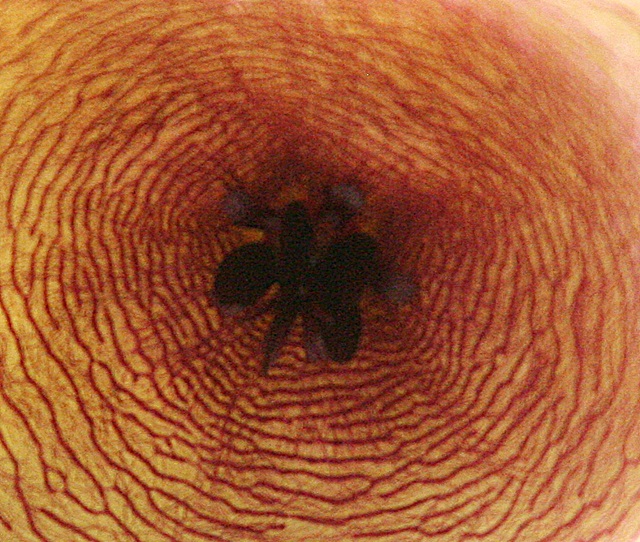
Inside the blossom is this circular fleshy disk, which, if you squint, looks a little like a fly. Perhaps this is meant to help entice flies to come inside? The blossom has a bit of a musty smell but isn't really very carrion-like.
This fascinating plant is native to South Africa. It needs well-drained soil and moderate water and full sun during the growing season. It can withstand extreme heat, as my plant has proved by living on a table in my backyard where it gets the full brunt of the afternoon sun all this extremely hot season. The plant will appreciate a cool, dry place to rest in winter. It spent last winter in my garage and did just fine, so I expect to put it back there this winter. The plant's normal bloom time is September so this one is right on schedule. It is full of many more buds of all sizes so I should be able to enjoy its unusual blooms for many weeks.
Stapelia gigantea really is such an interesting plant and brings back lovely memories of a nice day with gardening friends. As I always say, passalong plants are the very best kind of plants.
Subscribe to:
Posts (Atom)